
Q: What is astrology, really?
A: Astrology is the ancient study of how the positions of the Sun, Moon, planets, and stars connect to events and personality on Earth. It is one of humanity's oldest traditions — practised across every major civilisation for over 4,000 years — and while modern science classes it as a belief system rather than a proven one, it endures worldwide as a mirror for reflection and self-understanding.
From Babylon's clay tablets to today's newspaper horoscopes, here is the full story of where astrology came from, how it works, and why it still refuses to fade.
What Is Astrology?
At its heart, astrology is the study of the connection between celestial activity and earthly events. In my years around this work, I describe it simply: it is a form of divination that reads the apparent positions of celestial objects — the Sun, the Moon, and the planets — and interprets what those distant cosmic objects might mean for human affairs.
Astrologers observe where the planets were when you were born, note the sign each planet was in, and from that observation and interpretation build a picture of your personality, your relationships, and the road ahead. It is one of humanity's oldest traditions, with roots stretching back to the 2nd millennium BCE, when ancient cultures first turned calendrical systems and celestial cycles into signs of divine communications.
What makes astrology so rich is its sheer diversity of methods across cultures. There has never been a single unified theory: the zodiac in the West, Hindu astrology in South Asia, and the Chinese zodiac in East Asia each grew their own philosophies, and forms like Western astrology, Vedic astrology, and Tibetan astrology still thrive today.
Most people first meet it through their sun-sign horoscope — the simple newspaper-style reading based only on your date of birth — yet a fuller birth chart adds houses, angles, and the exact time of birth for a far more personal profile.
What Astrology Tries to Explain
In practice, people turn to astrology to explain and even predict the texture of everyday life. On a personal level, that means a weekly horoscope or monthly horoscope offering wellness insights, or a closer look at your career, your relationships, and your compatibility with others. On a wider scale, some astrologers stretch the same idea to forecast current events, social trends, financial markets, and even national affairs — a branch long known as Mundane Astrology, which examines world events, wars, and economies.
Others practise Interrogatory Astrology, which sets out to make specific predictions about a subject's objectives. What ties every branch together is a single hopeful belief: that the influence of the planets and stars can, in some quiet way, affect the fates of individuals, groups, and nations.
The Many Branches of Astrology
One thing I always tell newcomers is that there is no unified theory of astrology — only a rich diversity of methods and philosophies. The most personal form is Natal Astrology, built on your date of birth and rooted in what old texts call the Law of Beginnings: the idea that everything about a life is written into its very first moment. It is the branch most people mean when they say "astrology."
Around it sit countless others shaped by ancient cultures, from the calendrical roots in Mesopotamia to the systems of Ancient Greece and Rome, which later spread through the Islamic world and into Central and Western Europe.
A Science Once, a Belief Today
For most of its history, astrology was not the horoscope hobby we know now — it sat inside learned circles as a serious scholarly tradition, studied side by side with astronomy, meteorology, medicine, and even alchemy. It shaped decisions in political circles and echoed through literature, from Dante Alighieri and Geoffrey Chaucer to William Shakespeare, Lope de Vega, and Pedro Calderón de la Barca.
That standing changed with the Enlightenment. Once the scientific method took hold, researchers challenged astrology on both theoretical and experimental grounds, and it lost its academic standing, judged to have no explanatory power.
Astrologers had always faced detractors, competitors, and skeptics who opposed it on moral, religious, political, and empirical reasons — but this was the moment the pseudoscience verdict of modern Western science became settled. Even so, after a strong resurgence since the 1960s, millions still turn to it — not as hard proof, but as a mirror for reflection, meaning, and self-understanding.
Where the Word "Astrology" Comes From
Every so often, a word's etymology tells you more than its dictionary meaning ever could, and astrology is a perfect example. The word origin traces back to the early Latin word astrologia, which itself grew from the Greek ἀστρολογία. Break that Greek root apart and it becomes beautifully literal: ἄστρον (astron), meaning "star," joined with \-λογία (-logia), meaning "study of." Put together, astrology has always meant, quite simply, an "account of the stars." From Greek it passed into Latin, then travelled through medieval French before finally settling into the English language.
Here is the part I always find fascinating. For a long stretch of history, astrology and astronomy were nearly the same word, used almost interchangeably — astronomy itself comes from the parallel Latin astronomia.
The split came in the 17th century, when astronomy claimed its place as the scientific term for studying the heavens, while astrology drifted toward divinations and schemes for predicting human affairs. One name kept the telescope; the other kept the meaning.
The Nature and Significance of Astrology
At its core, astrology is a method of predicting mundane events built on one bold assumption: that the celestial bodies — the planets, the Sun, the Moon, and the stars in their arbitrary combinations and configurations — somehow determine or indicate changes on Earth.
That is the theoretical basis of all astrological theory, and the whole practice really becomes a language of astrological symbolism, where the motions of the stars are read as meaning. Historically, this idea grew out of Hellenistic philosophy, which set astrology apart from the older celestial omina, the sky "omens" first cataloged in ancient Mesopotamia.
The Ancient Model of the Sky
Early astrologers pictured a geocentric universe: a cosmos with the Earth at its center, the planets moving in orbits with the center of the Earth at their heart, and the fixed stars set upon great celestial spheres of finite radius.
Later, many adopted Aristotelian physics, which drew an absolute division between two kinds of movement — the eternal circular motions of the heavenly element above, and the limited, linear motions of the four sublunar elements below: fire, air, water, and earth. Within this frame, astrologers believed in special relations between the varied motions of the heavens and the endless generation and decay of the natural processes here on the ground.
Fire, Spirit, and the Platonic View
Not everyone reasoned like Aristotle. The followers of the Greek philosopher Plato — the Platonic astrologers — imagined the element of fire reaching up through the elemental world into the heavens themselves.
Because they believed in the deity's creation of the stars, they were far readier than the Aristotelians to accept divine intervention: the idea that celestial influences could carry a god's will directly into earthly life. It is a reminder that astrology was never one fixed doctrine, but a conversation the human mind kept having with the sky — one open enough to forgive an astrologer's errors as the fault of a system too vast to fully grasp.
The Role of the Divine and Free Will
Here is where things get genuinely interesting. In its strictest form, astrology imagines a purely mechanistic universe with no free will at all — a view that orthodox Christianity and Islam attacked fiercely. Others were gentler: for them, astrology was never an exact science like astronomy, only a reading of trends and directions that human will, divine will, or the very will of God could still change.
The Syrian Christian scholar Bardesanes — often identified as a Gnostic, a believer in esoteric salvatory knowledge and in the idea that matter is evil while spirit is good — taught that the stars govern only the material world, leaving the soul free to choose between good and evil, with true emancipation as its final goal.
How Different Faiths Answered
Different cultures answered the same question in their own voices. The Harranians of the ancient city of Harran and the Hindus treated the planets as potent deities, the navagrahas — planetary deities whose decrees could be softened through supplication, liturgy, and theurgy, the sacred art of persuading the gods and other supernatural powers.
In Hindu practice, this still lives on through ritual circumambulation, offerings, and puja to the planets in temples. Others, like the Christian Priscillianists — followers of Priscillian, a Spanish ascetic of the 4th century who held dualistic views — believed something quieter still: that the stars do not compel us at all, but simply make manifest the will of God to those trained to read the signs.
The Significance of Astral Omens
The idea that the stars simply reveal the divine will brings us very close to something far older than horoscopes: the ancient Mesopotamian collections of celestial omens. In my years studying this history, I have always found their purpose strikingly practical.
These astral omens existed for one primary purpose — to warn the royal court of impending disaster or coming success. Some pointed to meteorological or epidemic phenomena that could sweep through entire human, animal, or plant populations; others spoke to the military affairs of the state, or to the personal lives of the ruler and his family.
Here is the part that changes everything, though. The Mesopotamians did not read these signs as deterministic, but as indicative — a kind of symbolic language through which the gods communicated with men about the future, and only one part of a vast web of ominous events.
Because an omen is warned rather than sentenced, its unpleasant forebodings could be mitigated or even nullified through ritual means or contrary omens. This is where the bāru, the official prognosticator, earned his place: by observing and interpreting the celestial omina, he could advise his royal employer on avoiding misfortunes. In other words, the omens were never a sign of inexorable fate — they were a basis for intelligent action.
Why Astrology Survived Every Attempt to Kill It
Here is something no history book quite says out loud: astrology is the only "science" that was formally disproven and still grew. Most abandoned systems — alchemy, the four humours, the geocentric universe — quietly died once the evidence turned against them. Astrology did the opposite.
In my years studying this, I have come to see three reasons why:
- It answers a question science refuses to. Astronomy tells you what a planet *is*; astrology tries to tell you what it *means for you*. That hunger for personal meaning never went away — it simply outlived the proof.
- It adapts to every culture it touches. The same 12 signs became Hindu jyotisha, Chinese animal years, and Western sun-signs — each reshaped to fit local values. A belief that bends rarely breaks.
- Its decline and its comeback happened for the same reason. The Enlightenment pushed astrology out of universities in the 1600s; the anxieties of the 1960s pulled it straight back into popular culture. When life feels uncertain, people look up.
That is the real paradox of astrology. It was never strong because it was *true* — it was strong because it was *useful* to the human need for meaning. And that need, unlike any theory, has never gone out of date.
The Purposes of Astrology
The original purpose of astrology was beautifully personal: to tell someone the likely course of his life from the positions of the planets and the zodiacal signs — the twelve astrological constellations — at the exact moment of his birth or conception. This foundational science had a name, genethlialogy, the casting of nativities that we now call birth charts. From it, the fundamental techniques of all later astrology were born, and over time three great subdivisions grew out of it: general, catarchic, and interrogatory.
General astrology looks upward at the biggest scale. It studies how significant celestial moments — vernal equinoxes, eclipses, or planetary conjunctions — connect to social groups, nations, or all of humanity. In a sense, it answers by astrological means the very questions once posed in ancient Mesopotamia to the bāru.
Catarchic astrology takes a different angle entirely — its name points to beginnings and sources. It asks whether a chosen moment is favorable for starting a course of action, letting a person or a corporate body act at astrologically favorable times and, in theory, escape the failures that a rigorous reading of one's birth or a group's moment of origin might otherwise predict.
Interrogatory astrology is closer to a consultation. It answers a client's queries based on the situation of the heavens at the very moment the questions are posed. This astrological consulting service sits even further from determinism than catarchic astrology, which draws it nearer to divination by omens — and it traditionally insists on the ritual purification and careful preparation of the astrologer. Beyond these three, smaller variants branch off too, from iatromathematics — the application of astrology to medicine — to military astrology.
A Short History of Astrology
Long before science drew a hard line between the sky and the self, cultures everywhere were watching the heavens for meaning. The Indians, Chinese, and Maya each built elaborate systems for predicting terrestrial events from celestial observations.
A recognisable form of astrology was already being practised in the Old Babylonian period of Mesopotamia, around 1800 BCE, while in India the Vedāṅga Jyotiṣa — one of the earliest Hindu texts on astronomy and astrology, or Jyotisha — is dated by scholars as far back as 1400 BCE on astronomical and linguistic evidence. Further east, Chinese astrology took shape during the Zhou dynasty, between 1046 and 256 BCE.
The system we recognise today, though, was truly forged in Hellenistic astrology. After 332 BCE, Babylonian astrology blended with Egyptian Decanic astrology in Alexandria, giving birth to horoscopic astrology.
Alexander the Great's conquest of Asia carried these ideas into Ancient Greece and Rome, where they became known as "Chaldean wisdom." When Alexandria was conquered in the 7th century, Islamic scholars took the tradition up, translating the Hellenistic texts into Arabic and Persian; by the 12th century those Arabic texts were imported to Europe and translated into Latin.
What surprises most people is how respectable astrology once was. For most of its history it stood as a scholarly tradition, accepted in political and academic contexts and studied hand in hand with astronomy, alchemy, meteorology, and medicine.
Major astronomers — Tycho Brahe, Johannes Kepler, and Galileo — even served as court astrologers, and astrological references run through the works of poets like Dante Alighieri and Geoffrey Chaucer and playwrights such as Christopher Marlowe and William Shakespeare. That standing only faded at the end of the 17th century, when new scientific concepts in astronomy and physics — heliocentrism and Newtonian mechanics — called astrology into question. It slowly lost its academic and theoretical standing, and common belief in it has largely declined since.
Astral Omens in the Ancient Middle East
Long before horoscopes, the sky was read as a warning system. The astral omens used in Mesopotamian divination were later folded into what we now call astrology in the strict sense, forming the branch known as natural astrology. These were not personal readings but public ones — celestial omina studied for what they meant to the king and the state.
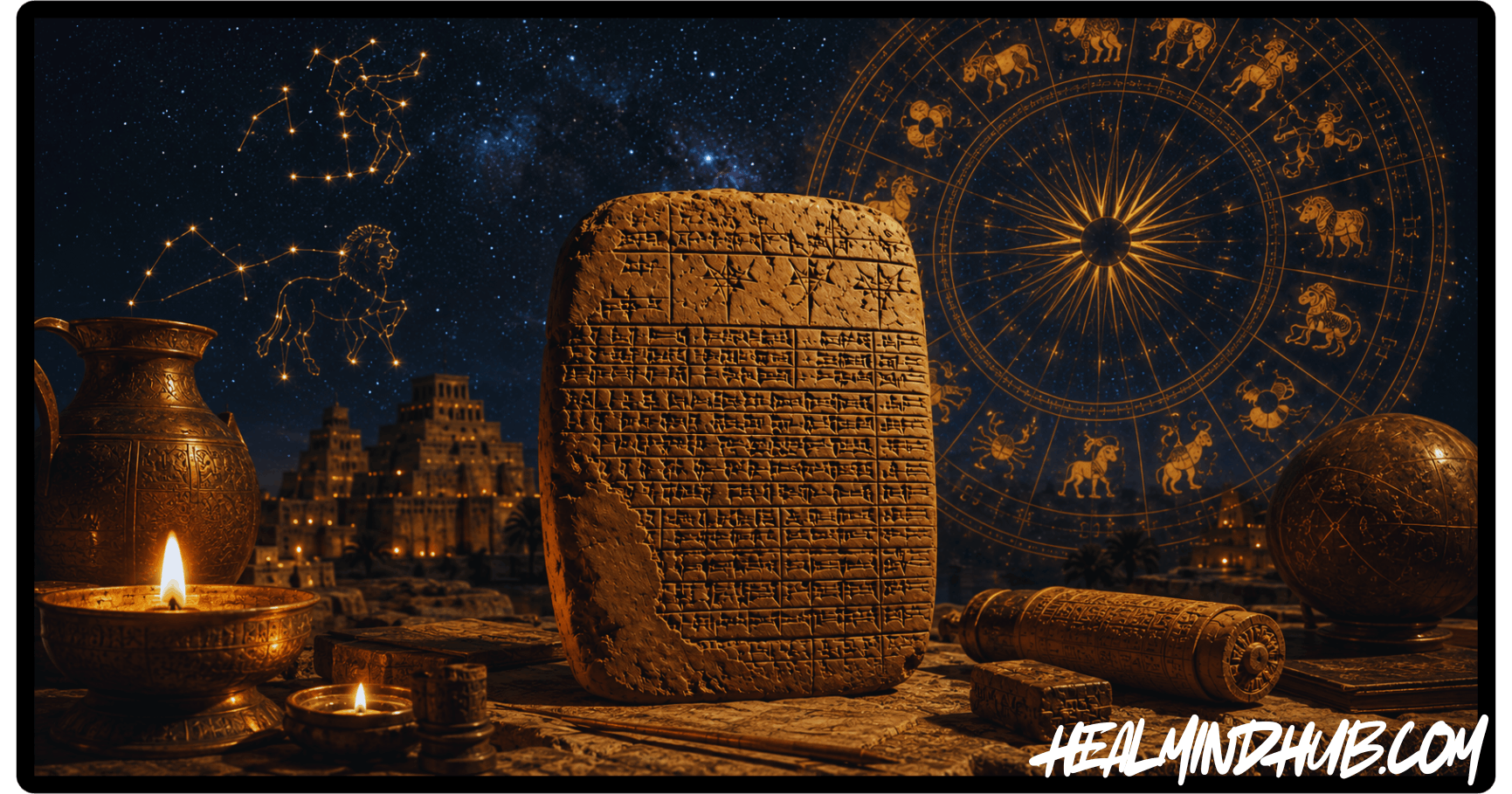
In my years tracing this history, I keep returning to one text above all: the Enūma Anu Enlil, a great cuneiform text begun during the 1st dynasty of Babylon, somewhere in the 18th to 16th centuries BCE, though its final collection and codification did not come together until the beginning of the 1st millennium BCE.
What fascinates me is that there was never a single "official" version. The surviving tablets — many from the Assyrian library of King Ashurbanipal in the 7th century BCE — show that no standard version ever existed.
Each copy carried its own characteristic contents and organization, shaped for its owner's consultation of the omens rather than for uniformity. Alongside them sat later works called Diaries and the older omen series, all part of the same long effort to make sense of the heavens.
The Four Gods of the Omens
The omens of the Enūma Anu Enlil fell into four common categories, each named for one of the chief gods behind the ominous communication:
- Sin (the Moon) governed lunar phenomena — first crescents, lunar eclipses, halos, and conjunctions with fixed stars.
- Shamash (the Sun) covered solar phenomena, including eclipses and the simultaneous observations of two suns, or perihelia — those eerie "additional suns."
- Adad (the weather god) ruled meteorological phenomena: thunder, lightning, cloud formations, and even earthquakes.
- Ishtar (Venus) held the planetary phenomena — first and last visibilities, stations (the points where planets appear to stand still), and acronychal risings, the rising of the planet in the east just as the Sun sets in the west.
How the Tradition Spread
For all their fame, these omens did not last forever. Reported for years by a network of observers across the Assyrian empire in the 7th century BCE, they slowly lost their popularity under the Persian domination of Mesopotamia, which ended in the 4th century BCE.
In their place came new works — the Diaries again — hunting for the correct correlations between celestial phenomena and terrestrial events. Yet the older ideas never truly died. Even before that decline, pieces of the omen tradition were transmitted to Egypt, Greece, and India, carried outward by the Achaemenian dynasty (559 to 330 BCE), whose reach stretched from Persia west to Macedonia and east to the Punjab.
How Astrology Spread: Egypt, Greece, India, and China
One of the most remarkable things about astrology is that it travelled. The Mesopotamian celestial omens did not stay in Mesopotamia — they moved along trade routes and conquests, changing shape with every culture they touched.
Into Egypt and Greece
The earliest sign of lunar omens reaching Egypt comes from a demotic papyrus, copied from an original of about 500 BCE during the Achaemenian period. Their wider spread, though, runs through the Greeks. A book written in Greek in the 2nd century BCE — claimed as a work addressed to a King Nechepso by the priest Petosiris — carried Mesopotamian ideas westward, and from sources like it the contents of Enūma Anu Enlil flowed into some of the most influential astrological texts ever written.
Chief among them was the Tetrabiblos — the Apotelesmatika, or "Work on Astrology," its "Four Books" compiled by Ptolemy, the Greek astronomer of the 2nd century CE. The same current fed the astrological compendium of Hephaestion of Thebes, a Greco-Egyptian astrologer of the 5th century CE, and the On Signs of John Lydus, a Byzantine bureaucrat of the 6th century.
A separate channel ran through the Magusaeans of Asia Minor — Persian settlers steeped in Babylonian ideas — whose teachings survive in works of natural history, above all those of Pliny the Elder (c. 23–79 CE) and the agricultural lore of the Geoponica.
Across the Middle East
The Middle East kept its own rich library of celestial omens, though scholars still debate how much descended straight from the Mesopotamian tradition and how much arrived through Greek or Indian intermediaries.
The most important of these texts are the ones ascribed to Hermes Trismegistos by the Harranians, now preserved in Arabic; the Book of the Zodiac of the Mandaeans, a Gnostic sect still living in Iraq and southwest Iran; the Apocalypse attributed to the prophet Daniel, surviving in Greek, Syriac, and Arabic versions; and The Book of the Bee, written in Syriac.
Into India, China, and Beyond
Astrology's journey eastward began with the Mesopotamian omen literature — the material of Enūma Anu Enlil — reaching India in the 5th century BCE, during the Achaemenid occupation of the Indus valley. Its first traces appear in Buddhist texts of that period, and it was Buddhist missionaries who then carried this knowledge onward into Central Asia, China, Tibet, Japan, and Southeast Asia.
The oldest surviving work of this Indian tradition, written in Sanskrit, is the earliest version of the Gargasamhita — the "Compositions of Garga" — from about the 1st century CE. Here the borrowed Mesopotamian material was reshaped to fit Indian society, woven into the system of the four varnas and the duty of the upper varnas to perform the samskaras, the sanctifying ceremonies of life.
Many later compilations followed, most notably the Brhatsamhita, or "Great Composition," of Varahamihira (c. 550), the Jain Bhadrabahu-samhita (c. 10th century), and the Parishishtas, or "Supplements," of the Atharva Veda (perhaps the 10th or 11th century) — though these added little that was new.
The real shift came later. In the works from the 13th century onward, known as Tājika, a massive wave of Arabic adaptations of those originally Mesopotamian omens flowed back into India through Persian translations. Tājika astrology tied the omens tightly to everyday, popular concerns — a clear turn away from the older Sanskrit texts, where astrology had served mainly military and catarchic ends, the art of choosing an opportune moment to act.
Chinese Astrology: A System of Its Own
Here is something worth clearing up first. Although some earlier scholars suspected a Mesopotamian influence on Chinese astrology, 21st-century research points the other way: the Chinese astrological system almost certainly developed independently. The Chinese zodiac may trace back to the Warring States period (475–221 BCE); other scholars place its start in the Qin dynasty (221–207 BCE), and still others in the Han dynasty (206 BCE–220 CE). By the latter half of the Han dynasty, it was firmly woven into Chinese cultural life.
How the Chinese Zodiac Works
At its heart, the Chinese zodiac is an annual classification system that follows the Chinese lunar calendar, the yingyang li — literally "heaven-earth." Each year in a 12-year cycle is assigned an animal, and that animal is thought to shape the personality of everyone born within it.
The cycle turns to a new animal at Chinese New Year, which lands between January 21 and February 20 on the Gregorian calendar, then restarts once all 12 animals have had their turn. This is the key difference from the Western zodiac system: the Western signs are based on months named for constellations, while the Chinese sign changes with each year rather than each month.
Layered on top of this is the ancient Chinese cosmology of wuxing — the five basic elements of earth, wood, metal, fire, and water. These elements are believed to underlie the universe, and their cycles explain change in the cosmos. When this cycle of elements intersects with the cycle of 12 zodiac animal signs, it produces specific element-and-animal combinations, giving astrologers far greater predictive specificity in their astrological calculations.
Many countries across east and southeast Asia, neighbouring or shaped by China, later adopted the Chinese zodiac, often giving it their own unique recastings.
The Philosophy Behind It
Chinese astrology sits close to Chinese philosophy, especially the theory of the three harmonies — heaven, earth, and man. It draws on concepts like yin and yang, the Five phases, the 10 Celestial stems, the 12 Earthly Branches, and shichen, a form of timekeeping once used for religious purposes.
In its early days, its use was mostly political astrology: observing unusual phenomena, identifying portents, and selecting auspicious days for important events and decisions.
Notably, the constellations of the zodiac of western Asia and Europe were never used here. Instead, the Chinese sky is divided into the Three Enclosures (sān yuán) and the Twenty-Eight Mansions (èrshíbā xiù) across twelve Ci.
The Twelve Animals
The twelve animal signs are said to represent twelve different types of personality, built on cycles of years, lunar months, and even two-hour periods of the day.
The cycle traditionally begins with the Rat, then moves through the Ox, Tiger, Rabbit, Dragon, Snake, Horse, Goat, Monkey, Rooster, Dog, and Pig. Beyond the simple animal sign, complex systems for predicting fate and destiny — based on one's birthday, birth season, and birth hours, such as ziping and Zi Wei Dou Shu — are still used regularly in modern-day Chinese astrology, and notably, they rely on calculation rather than direct observation of the stars.
Neighbouring Zodiacs
The idea spread, and each culture made it their own. The Korean zodiac is identical to the Chinese one. The Vietnamese zodiac is almost identical too, except the second animal is the Water Buffalo instead of the Ox, and the fourth is the Cat instead of the Rabbit.
The Japanese have, since 1873, marked the new year on 1 January under the Gregorian calendar. And the Thai zodiac begins not at Chinese New Year but either on the first day of the fifth month of the Thai lunar calendar or during the Songkran festival, now held every 13–15 April.
Astrology in the Hellenistic period (3rd century bce to 3rd century ce)
How Astrologers Built the Horoscope
By the 3rd century BCE, and perhaps earlier, Babylonian diviners had begun using planetary omens to predict the course of a single life — reading positions relative to the horizon, latitudes, retrogressions, and other placements at the moment of birth or computed conception. It was not yet astrology as we know it, but it grew up alongside genethlialogy, the casting of birth charts that was taking shape in Hellenistic Egypt.
The Macrocosm and the Microcosm
Under the Ptolemies, the Greek dynasty ruling Egypt from 305 to 30 BCE, thinkers turned a poetic idea into a mathematical one: that the macrocosm — the "larger order," or universe — mirrors the microcosm, the "smaller order," which is man.
Read through Platonic and Aristotelian theories that placed the Earth at the center of the planetary system, they divided the ecliptic — the apparent orbital circle of the Sun — into 12 equal parts of 30° each, the zodiacal signs, exactly as the Babylonians had done.
Signs, Houses, and Degrees
From there the detail multiplied. Each of the 12 signs became the domicile, or house, of a planet, and each was subdivided further — into decans of 10°, fines or "bounds" of varying lengths, and dōdecatēmoria of 2°30′ each — with every part ruled by a planet. Scattered along the ecliptic sit each planet's degrees of exaltation, its points of high influence, opposite to its degrees of dejection, or low influence.
A planet's strength in a birth chart depends partly on where it falls among these arcs of the zodiac, and on whether it sits among its friends or its enemies.
Each zodiacal sign also answers to a part of the human body. The 12 signs group into four triplicities, each governing one of the four elements, while numerous pairs of opposites — male-female, diurnal-nocturnal, hot-cold — drawn from the followers of Pythagoras, the Greek mystical philosopher of the 6th century BCE, attach to consecutive pairs of signs.
On top of all this, a wide range of substances in the elemental world and traits of human character were loosely tied to the signs, and these lists of interrelationships became the rationale behind the astrologer's predictions.
How Planets Gain Their Power
A planet's influences flow from two springs: its old general indications as something ominous in Mesopotamian texts, and the character of its presiding deity in Greek mythology. Over these were layered the four elements and their four qualities, the Pythagorean opposites, and long lists of sublunar substances. As in the omens, the modes of the planetary motions matter too, since a planet's strength depends partly on its phases with respect to the Sun.
Planets also shape one another — by occupying each other's houses and through conjunction and aspects. Opposition (to the 7th) and quartile (to the 4th or 10th) are generally read as bad, while trine (to the 5th or 9th) and sextile (to the 3rd or 11th) are generally read as good.
The Rising Signs and the Twelve Places
Because the planetary orbits turn from west to east, the zodiac appears to rotate daily around the Earth the other way. From any spot on the surface, the signs seem to rise one after another above the eastern horizon.
Astrologers call the sign momentarily rising the first place, the next the second, and so on, with the one that rose just before the ascendant becoming the 12th. In genethlialogy, each place in this dōdecatropos governs a part of the life of the native — the person born under that sign — while in other branches it governs some matching corner of the sublunar world.
Reading the Horoscope
To cast a horoscope, astrologers first fix, for the exact moment and place, the boundaries of the 12 places and the longitudes and latitudes of the seven planets. Then they read it — studying the intricate geometric interrelationships between the signs, their parts, and the planets of varying computed strengths, and pairing each element with its list of sublunary correspondences.
Any horoscopic diagram will throw off a vast number of predictions, some of them contradictory or extravagant. This is the honest part few admit: astrologers lean on their sense of the client's social, ethnic, and economic background — and on plain experience — to avoid error and hold on to credibility.
Later Refinements
Since about 100 BCE, this has been the essential procedure of astrology, though refinements crept in over time, several tied to the Hermetic tradition of Hermes Trismegistos and to Dorotheus of Sidon, an influential astrological poet of the late 1st century CE. One was the system of lots — influential points set as far from a chosen spot in the diagram as two planets are from each other.
Another was the prorogator, a point on the ecliptic that travels at one degree of oblique ascension a year toward the descendant or ascendant to measure a person's length of life. A third was continuous horoscopy, in which anniversary diagrams are compared against the base nativity for annual readings. And finally, certain periods of life were handed to governing planets in a fixed sequence — these period governors then sharing their authority with other planets through granted subperiods.
Astrology after the Hellenistic period
Astrology in India: The Birth of Jyotisha
When Greek astrology travelled to India in the 2nd and 3rd centuries CE, it arrived through a handful of Sanskrit translations. The most famous was made in 149/150 by Yavaneshvara and later versified as the Yavanajataka by Sphujidhvaja in 269/270. These early translators mapped the 12 signs of the Western zodiac directly into Sanskrit and set them beside the astrological ideas India already held. This is why the techniques of Indian astrology — jyotisha — look so similar to their Hellenistic counterpart.
What India Changed
The techniques crossed over, but the philosophy did not. Where the Greeks leaned on their own theories, Indian astrologers substituted divine revelation, and they reshaped predictions built for Greek and Roman society so they made sense in an Indian cultural context. That meant folding in the varna and caste systems, the doctrine of metempsychosis — the transmigration of souls, or reincarnation — the Indian theory of five elements (earth, water, air, fire, and space), and India's own systems of values.
A Richer, More Elaborate System
If anything, Indian astrologers made an already complex craft even deeper. They introduced the nakshatras, or lunar mansions, drawn from older Vedic astrological material. They built out three categories of yogas (planetary combinations), dozens of dashas (planetary periods) and antardashas (subperiods), and an intricate theory of ashtakavarga rooted in continuous horoscopy.
They also multiplied the subdivisions of the zodiacal signs — adding the horas (15° each), the saptamshas (4 2/7° each), and the navamshas (3°20′ each) — and expanded the roster of planets. To the classical set they added the nodes of the Moon (where the lunar orbit crosses the ecliptic) and a series of upagrahas, or imaginary planets.
Above all, they integrated the system of nine planets, the navagrahas, which includes two shadow planets blamed for harm and eclipses. Several Hellenistic features and their Sāsānian offshoot — the lots, the prorogator, the Lord of the Year, the triplicities, and astrological history — only reached India much later, in the 13th century, through the Tājika texts.
The Branches Indians Favoured
Beyond genethlialogy — the casting of birth charts — Indian astrologers especially prized military astrology and a form of catarchic astrology called muhurta-shastra, the art of choosing an auspicious muhurta (a span of about 48 minutes) to begin something. Iatromathematics and interrogatory astrology were practised too, though to a lesser degree.
The Classic Texts
Classical Indian astrology rests on a few early medieval compilations, above all the Bṛhat Parāśara Horāśāstra and the Sārāvalī of Kalyāṇavarma. The Horāshastra is a composite of 71 chapters: its first part (chapters 1–51) dates to the 7th and early 8th centuries, and its second (chapters 52–71) to the later 8th century, while the Sārāvalī dates to around 800 CE. English translations of both were eventually published — by N.N. Krishna Rau in 1963 and V.B. Choudhari in 1961\.
Astrology in Sāsānian Iran
Soon after Ardashīr I founded the Sāsānian empire in 226 CE, Iran became a meeting point for the great astrological traditions. A substantial transmission of both Greek astrology and Indian astrology flowed into the region, preserved through Pahlavi — the Iranian language — translations of figures like Dorotheus of Sidon, Vettius Valens, Hermes, and an Indian teacher known in the Arabic sources as Farmasp. There is a poignant catch here: the Pahlavi originals are all lost, so these later translations became our only window into the Sāsānian science.
In practice, genethlialogy in Iran was largely an imitation of the Hellenistic model, stripped of its philosophy, onto which a few Indian features were grafted — the navamshas, for instance, and a Shaivite reading of the old Greco-Egyptian deities of the decans. But the Sāsānian astrologers gave the world one genuinely original idea: the theory of astrological history.
This was the bold attempt to write history itself, both past and future, by stretching the familiar tools of Hellenistic genethlialogy — the prorogator, the Lord of the Year, the planetary periods, and continuous horoscopy — across whole eras. They fused it with Zoroastrian millenarianism, the belief that the finite duration of the material creation is divided into 12 millennia.
Astrology in the Islamic World
By the 8th and 9th centuries, astrology poured into Islamic civilization through three streams at once — Hellenistic, Indian, and Sāsānian. Arabic translations from Greek and Syriac carried the Hellenistic science; translations from Sanskrit brought the Indian version; and Pahlavi sources delivered the Sāsānian blend of the two. It was a rare moment when three great traditions met in one language.
The House of Wisdom
This gathering had a home. After Alexandria fell to the Arabs in the 7th century and the Abbasid empire rose in the 8th, the second Abbasid caliph, Al Mansur (754–775), founded Baghdad as a centre of learning.
At its heart sat a library-translation centre known as Bayt al-Hikma, the "House of Wisdom," which his heirs kept expanding and which drove a great wave of Arabic-Persian translations of Hellenistic astrological texts. Among its early translators were Mashallah — who helped elect the very time for the foundation of Baghdad — and Sahl ibn Bishr, known as Zael, whose work later shaped European astrologers like Guido Bonatti in the 13th century and William Lilly in the 17th.
Abū Maʿshar and the Turn Toward Europe
The towering figure of this era was Abū Maʿshar — known in Latin as Albumazar — in the 9th century. Islamic astrology, through his work, absorbed the Harranian adaptation of the Neoplatonic definition of astral influences, explained in terms of Aristotelian physics.
He deepened the Sāsānian theory of astrological history and greatly expanded the number of lots an astrologer had to weigh. When his works were translated into Latin in the 12th century, they became a driving force behind medieval European as trology.
Muslim scholars gave particular attention to catarchic and interrogatory astrology. Yet astrology also drew fierce fire from the theologians, who condemned it for denying divine intervention in the world and man's free will.
After the Mongol invasions of the 13th century, its appeal to Muslim intellectuals declined sharply — but not before its influence had already spread into India, the Latin West, and Byzantium. Knowledge of these Arabic texts began flowing into Europe through the Latin translations of the 12th century.
Astrology in Byzantium
During the last great upsurge of paganism in the 5th and 6th centuries CE, Byzantium — the Eastern Roman Empire — was home to a whole circle of astrologers: Hephaestion, Julian of Laodicea, Proclus, Rhetorius, and John Lydus. Their works were, to be honest, largely unoriginal compilations, yet that is exactly what makes them precious. Because so much older material is lost, these copies remain our major sources for understanding earlier Hellenistic astrology.
The tide soon turned against them. By the end of the 6th century, the general decline of the Byzantine Empire's intellectual life, combined with strong opposition to astrology within Christianity, had all but obliterated the discipline — though the quieter habit of reading celestial omens survived here, just as it did in western Europe.
The science was only revived in the late 8th and 9th centuries, carried back to life by translations from Syriac and Arabic. Its golden stretch ran from about 800 to 1200, even if nothing genuinely new was added to astrological theories or techniques. That era was matched only by one final flowering in the late 14th century, when John Abramius and his students revised the older astrological treatises in Greek, handing the Renaissance the vulgate texts it would build upon.
Astrology in Western Europe
For centuries, astrology barely spoke Latin. Almost every astrological text of the Roman Empire was written in Greek, and the few Latin exceptions — the poem Astronomica of Manilius (c. 15–20 CE), the Matheseos libri, or "Books on Astrology," of Firmicus Maternus (c. 335), and the anonymous Liber Hermetis, the "Book of Hermes," from the 6th century — were oddly useless in practice, because there were no astronomical tables in Latin to work them.
So when knowledge of Greek faded, astrology quietly disappeared from western Europe altogether.
The Great Revival
Its return came from translation. In the 12th and 13th centuries, a flood of Arabic astrological and astronomical treatises was rendered into Latin in Spain and Sicily, supplemented by a handful of works taken straight from the Greek. Yet this new astrology in the Latin-reading world stayed essentially an offshoot of Islamic astrology, and only in the 15th and 16th centuries did it finally recover a full picture of its Hellenistic originals.
Those same two centuries were its golden age in Europe — the era when the prophecies of the French astrologer Nostradamus (1503–66) won him widespread fame and a place in the French royal court.
The Scientific Revolution and Decline
Then came the reckoning. By the 17th century, astrology steadily lost its intellectual viability against the advances of the Scientific Revolution. As Copernicus (1473–1543), Galileo (1564–1642), and Johannes Kepler (1571–1630) pushed the Earth out of the center of the universe, and as the mechanistic physics of Descartes (1596–1650) and Newton (1643–1727) took hold, astrology came to be seen as scientifically untenable.
The irony is worth savouring: Kepler himself, for all his breakthroughs in planetary astronomy, still believed in the predictive value of astrology, and even tried to devise a fresh method of computing astrological influences that would fit a heliocentric, Sun-centered universe.
Astrology in Modern Times
Astrology never really left us — it simply changed its address. In countries like India, it still holds a surprising position among the sciences. Its continued legitimacy shows in a striking fact: some Indian universities offer advanced degrees in astrology. Everyday life reflects this too, as many Indians consult astrologers for birth charts, wedding dates and times, business transactions, the right moment to move into a new house, and other major life events.
The Western Story
In the West, the path ran differently. Newtonian physics and Enlightenment rationalism largely eradicated widespread belief in astrology — and yet Western astrology is far from dead. It won a strong popular following in the 1960s, and there were even attempts to rebuild a theoretical basis for it, most notably by the French psychologist Michel Gauquelin in his The Scientific Basis of Astrology (1964), though the results were, at best, inconclusive.
Meanwhile, the familiar divisions of the year governed by the 12 zodiacal signs — inherited straight from Hellenistic astrology — kept their hold through newspapers, manuals, and almanacs, feeding popular belief or, at the very least, offering entertainment.
The Skeptics' Challenge
Modern astrologers have worked hard to keep up with the sky itself. They have tried to fit the planets discovered since the Renaissance — Neptune, Uranus, and, for a time, Pluto — into the older astrological scheme, and to find some statistical relation between planetary positions and human lives. To skeptics and critics of astrology, none of it convinces. No serious explanation has emerged for the supposed spheres of influence of the planets, the nature of those influences, or the way they are meant to operate.
Why It Still Endures
And still, people come. Astrology continues to draw individuals from all walks of life — from the casual followers who scan their horoscopes in the daily newspaper to those who have their star charts drafted by professional astrologers.
The cultural critic Theodor W. Adorno, in his close reading of the astrology section of the Los Angeles Times in "The Stars Down to Earth" (1974), argued that newspaper astrology columns lean on a mix of rhetorical strategy and popular psychology, quietly speaking to readers' anxieties in contemporary culture. In the end, even where it is judged to hold no intellectual or scientific value, astrology — in both its modern and historical forms — remains endlessly fascinating to scholars and the wider public alike.
Beyond the Stars — Astrology can be a beautiful mirror for reflection, but real change comes from within. Dr. Dan Amzallag offers life coaching to help you understand yourself and move forward with clarity.
→ Book a session (`?ref=hmh-astrology`)
*Dr. Dan is a licensed coach and therapist, not an astrologer.*
Astrology at a Glance
| Aspect | Key Facts |
|---|---|
| What it is | The study of how celestial positions connect to earthly events and personality |
| Age | Over 4,000 years old (Babylon, c. 1800 BCE) |
| Origin | Ancient Mesopotamia, spread to Egypt, Greece, India, China, and beyond |
| Main branches | Natal, Mundane (general), Catarchic, Interrogatory |
| Cultural systems | Western, Vedic (Indian), Chinese |
| Scientific status | Classed as pseudoscience since the Enlightenment |
| Why it endures | Used as a mirror for reflection, meaning, and self-understanding |
Conclusion
The Takeaway
Astrology has worn many faces across 4,000 years — a royal warning system in Babylon, a respected science in Ptolemy's Greece, a courtly art in Kepler's Europe, and today, a personal language of meaning. It rose, fell, and rose again, not because it was ever proven, but because it answered a question science never tried to: *what does all this mean for me?*
Whether you read it as history, symbolism, or a mirror for self-reflection, astrology remains one of humanity's most enduring conversations with the sky. The stars may not command your fate — but the story written in them is very much worth knowing.
FAQ
What is astrology in simple words?
Astrology is the belief that the positions of the Sun, Moon, planets, and stars at the moment of your birth influence your personality and life events. It works by mapping those positions onto a chart and interpreting their meaning.
How old is astrology?
Astrology is over 4,000 years old. A recognisable form was practised in the Old Babylonian period of Mesopotamia around 1800 BCE, and India's Vedāṅga Jyotiṣa dates back as far as 1400 BCE.
Is astrology a science?
No. Astrology was once studied as a science alongside astronomy, but since the Enlightenment and the Scientific Revolution it has been classed as a pseudoscience, with no proven scientific validity. Many people still value it as a tool for reflection rather than prediction.
What is the difference between astrology and astronomy?
Astronomy is the scientific study of celestial objects and how they physically behave. Astrology is the interpretive tradition that reads meaning into those objects' positions. The two were once the same word and only split in the 17th century.
What are the main types of astrology?
The three classical branches are natal (based on your birth), general or mundane (world events), and interrogatory (answering specific questions). The three living cultural systems are Western, Vedic (Indian), and Chinese astrology.
Why do people still believe in astrology today?
People turn to astrology for meaning, reflection, and reassurance, especially in uncertain times. Its popularity surged in the 1960s and remains strong, functioning for many as a language for self-understanding rather than literal prediction.
Birth chart deep-dives, horoscopes, transit guides and compatibility articles — free, straight to your inbox.
🔒 No spam. Unsubscribe anytime. Available in English and French.